Loading Help…

How the competence model fits together, and what the IRI and ICI actually mean. Drawn from the BIMe/BFB authoritative sources.
A Role brings together Competency Profiles; each Profile groups related competency items. Profiles can be shared across roles.
Accreditation and certification are not one thing done by one actor. They are a chain of distinct roles done by distinct parties — and RPF is the framework layer at the start of the chain.
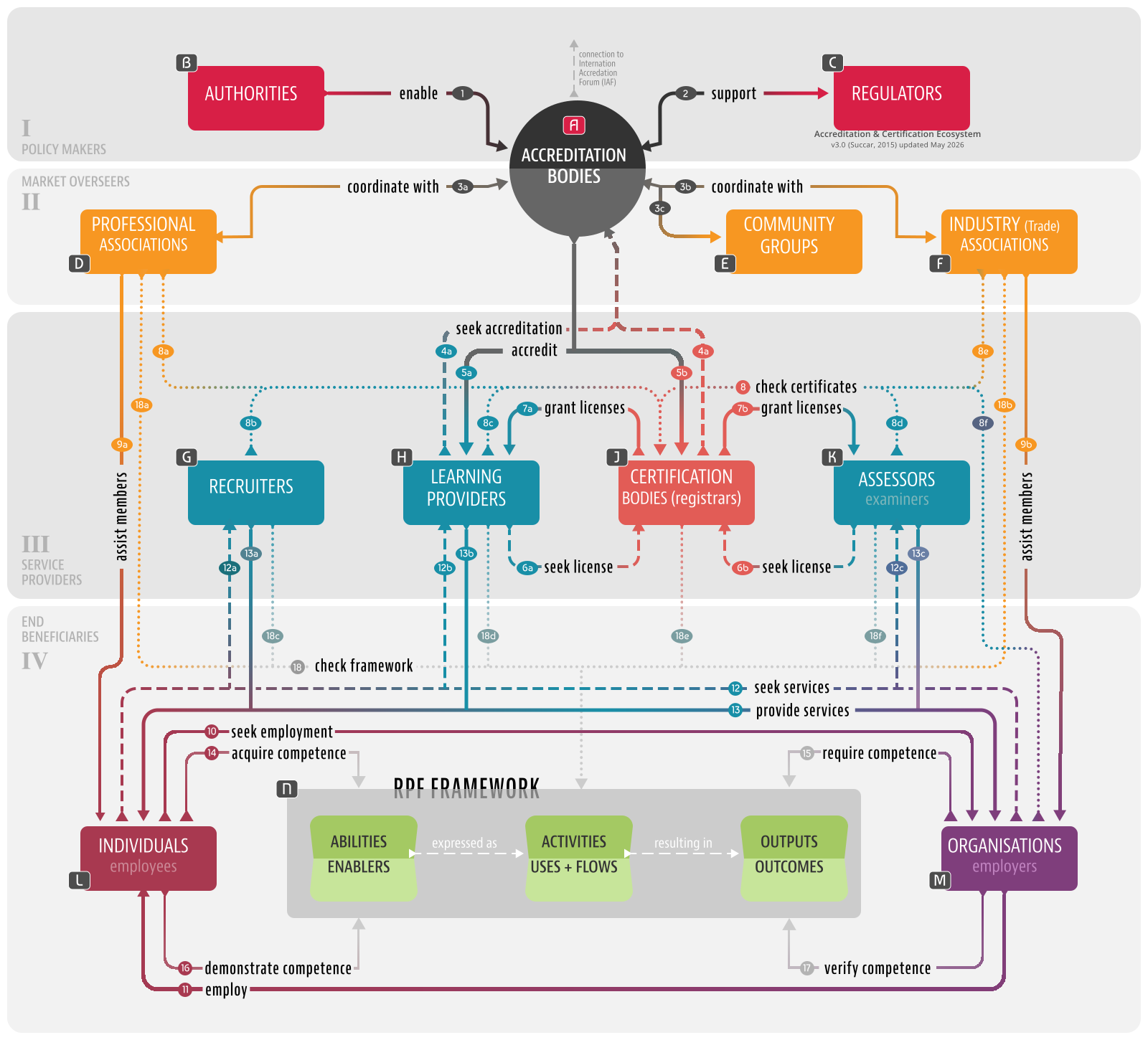
The diagram places RPF at the centre as the framework layer (Node N). Around it sit the actors with distinct authority that reference, accredit, assess, issue or check against the framework: accreditation bodies accredit learning providers and certification bodies; assessors assess people; certification bodies and credential platforms issue, sign and check credentials; regulators and authorities set the rules; professional, industry or community bodies may recognise roles; learning providers deliver training; employers and recruiters consume credentials. RPF is the framework those actors check against — it is none of them.
Around RPF sit distinct actors with distinct authority: accreditation bodies accredit learning providers and certification bodies; assessors assess people; certification bodies and credential platforms issue, sign and check credentials; regulators and authorities set the rules; and professional, industry or community bodies may recognise roles.
RPF defines and publishes the roles, profiles and flows the other actors reference. It does not accredit, assess, certify, issue, sign, check, or store credentials. It records a body's recognition of a role and produces credential templates based on its framework — and stops there.
A simplified view of the competence model: Roles, Profiles and Items, with indices and classifications describing their relationships.
A role (e.g. BIM Manager, Junior Architect) carries scale, type, rank, discipline and region. It is the outer container that holds the profiles required to perform it.
A Competency Profile groups related competencies (e.g. BIM Fundamentals or Model-based Collaboration). A Profile may be core or specialised and can be reused across roles.
The atomic unit. An item specifies knowledge, skill and outcome in a structured, assessable sentence.
Once a persona's role and competency profiles are defined, a flow translates them into a project journey. Each flow is the navigational layer over the BIM ecosystem: a sequence of stages that point the practitioner to the relevant standard, support, or guide at each step.
An ordered card with a title, an information-management responsibility, plain-language guidance, and links to the ecosystem materials that resolve it. Stages compose into the flow the profile follows.
First-class entries from the existing ecosystem (ISO 19650, CWMF, the Irish BIM Mandate, Build Digital, etc.). Each stage links materials by relevance — primary, supporting, or reference.
When no existing support resolves a stage, the flow flags it with a priority and panel evidence. Flags aggregate into the prioritised gap register that identifies where further supporting material may be needed.
Every stage→material edge is recorded in the cross-reference register so the library stays coherent as standards evolve and new supports are added.
Every item is an Action Statement: a structured sentence that defines an activity, output, or outcome. Each one begins with a verb from a fixed taxonomy and references terms drawn from international standards (ISO 19650, the BIMe Dictionary).
establish the project’s Information RequirementInformation Requirement — Description unavailable.s
“Establish the delivery team's mobilization plan.”
“Identify the assets for which information shall be managed.”
“Determine if the project team is capable of managing federated models.”
The governed Activity Type taxonomy each statement is classified against. Codes are grouped by category — Action (A), Enquiry (E), Capability (C).
| Code | Expression | Description |
|---|---|---|
| A1 | Do (x)do-x | The most generic syntax governing an action within a Statement. To do is to generate, organise, manage, maintain, and similar actions that are not specific enough to warrant their own syntax. |
| A2 | Assess (x)assess-x | Covers the action of assessing and evaluating an actor, service, or product. It is not intended to determine the result of that assessment. |
| A3 | Learn (x)learn-x | Gaining conceptual and practical knowledge by an actor. Learning can be structured (e.g. through neural networks) or through studying, imitation, and practice. Organisational learning is also covered through recruitment of learned individuals and procurement of expert systems. |
| A4 | Teach (x)teach-x | To teach, train, or demonstrate a concept or a solution. To guide others. |
| A5 | Certify (x)certify-x | To formally attest to, accredit, or issue a credential confirming that an actor, service, or product meets a defined standard. The act of conferring formal recognition — distinct from assessing (A2) or determining capability (C1). |
| A6 | Define (x)define-x | This syntax covers statements that describe / specify what needs to be done or delivered rather than the act of doing or delivering. |
| E1 | Establish if (x) is availableestablish-x-available | Establish if an artefact, role, or system is in place. Use with Establish or Determine. |
| E2 | Identify (x)identify-x | Identify an actor, organisation, project or system. Establish the type(s) of actors, organisations, etc. |
| E3 | Provide information about (x)provide-information-x | Supply, share, report, or make available information, data, or documentation about an actor, artefact, project, or system — without evaluating or determining it. |
| E4 | Determine [attribute] of (x)determine-x-attribute | An [attribute] refers to cost, speed, or similar; attributes derived from the BIM Ontology. An [attribute] can also refer to general indicators similar to applicability and affordability. |
| E5 | Determine if (x) has occurreddetermine-x-occurred | Establish whether an event, action, or milestone has taken place. Confirms occurrence (yes / no), not the attributes (E4) or accuracy (E8) of the thing. |
| E6 | Determine if (x) meets condition (y)determine-x-conformant-y | Establish whether an actor, artefact, or system satisfies a stated condition, requirement, or threshold (y) — a conformance check returning a met / not-met result. |
| E7 | Determine if (x) is aware of (y)determine-x-aware-y | Establish whether an actor or organisation has knowledge or awareness of a concept, requirement, or piece of information (y). |
| E8 | Determine if (x) is true or accuratedetermine-x-true | To be used for statements that attempt to confirm, verify, or validate if an action has occurred or if the input is accurate and the claim is true. |
| C1 | Determine if (x) is capable of doing (y)determine-x-capable-y | Determine if an actor — a human or machine — is capable of performing a task or delivering a service / product. At the end of this determination, a result must become known: either Actor x is capable or not capable. Capability includes both Readiness (having the abilities / tools) and past Experience. |
| C2 | Rate the capability of (x)rate-x-capability | Assign a graded score, level, or rating to an actor's capability, rather than the binary capable / not-capable result of C1. Produces a position on a defined capability scale. |
| C3 | Compare the capability of (x) against condition (y)compare-x-capability-y | Evaluate an actor's capability relative to a benchmark, requirement, or another actor (y), producing a relative result (e.g. meets / exceeds / falls short). |
| C4 | Establish the qualifications of (x)establish-x-qualification | Identify and verify the formal qualifications, credentials, certifications, or accreditations held by an actor. |
Every role↔profile edge carries both. They answer different questions.
Differentiates competencies by their importance to role performance, from Not Required (0) to Required (4).
Competencies outside the profile scope for this role.
Supplementary competencies — nice to have, but not needed to perform the role.
Performance-enhancing competencies that improve outcomes without being standard practice.
Standard-practice competencies that a practitioner in this role should hold.
Critical, non-negotiable competencies without which the role cannot be performed.
Measures an individual's ability to perform a defined activity or achieve a specified outcome, from No Competence (0) to Expert (4).
No demonstrable ability in the subject area.
Understands fundamentals and has some initial practical application.
Solid conceptual understanding and some practical application.
Significant conceptual knowledge and substantive practical experience.
Extensive knowledge, refined skill, and prolonged experience in the activity.
Each profile is attached to a role with a classification that describes how central it is.
Universally applicable to every defined role — foundational BIM competencies.
Central to the role's scope of work — the competencies that define day-to-day delivery.
Secondary competencies that complement the primary set without defining the role.
One worked example. The same encoding is used everywhere IRI/ICI appear together.
Core · Individual Responsibility Index 4 (Required) · Individual Competency Index 3 (Advanced).
The hue marks the classification. The outline thickens with IRI depth — the higher the responsibility, the more prominent the edge. The small filled square saturates with ICI depth. Numbers (R for IRI, C for ICI) are always visible for precision.
An empty cell means no edge is defined between that role and profile at this version of the framework.
Definitions of the main RPF constructs and how they relate to one another.
An organisational position composed of one or more Profiles. Roles vary by jurisdiction even when they share a name — e.g. Architect in the UK vs Niger carries different obligations.
A generic container of competency Statements and Information Uses. Profiles are the building blocks of Roles; one Profile can appear in many Roles.
A canonical container for the types of information work a profile performs, defined per the BIMei 211in document. Three branches: Model Uses (MU), Document Uses (DU), Data Uses (dU). IUs link to Roles transitively via Profiles.
A single competency statement — an action a profile can perform. Items belong to Profiles and may be linked to Materials.
A document or artefact used as supporting material (e.g. a standard, clause, template or guide). Its publisher is recorded as the Source; citations locate the relevant content.
The publisher or issuing organisation behind Source Materials (e.g. a standards body, regulator or professional association). A citation identifies supporting content within a Source Material.
An ordered sequence of activities. Flows attach to Profiles only; Roles reach Flows transitively via their Profiles.
A user-specific combination of a Role, current and target Profiles, and a Flow of activities for examining the differences. A Persona is distinct from both a Role and a Profile.
A scoping context — a country, sub-national region (e.g. Quebec), or supra-national bloc (e.g. EU) — that governs which Materials, Profiles, and Roles apply.
The second Analyser: it ingests a project programme, extracts statements and flows, and identifies the competencies needed to deliver the project. Previously called the Project Planner. Distinct from the Persona Analyser.
Project documents that ship with this app, and the foundational publications behind Project C.
BIM ThinkSpace (2024), Episode 25. bimthinkspace.com/2024/11/episode-25-redefining-competence.html
Succar, B., Sher, W., & Williams, A. (2013). Automation in Construction. doi:10.1016/j.autcon.2013.05.016 · bit.ly/BIMPaperA6
BIMei (2016). bimexcellence.org/resources/200series/201in
BIMei (2015). bimexcellence.org/resources/200series/211in
BIMei (2020). bimexcellence.org/resources/300series/351in-model-use-templates-guide