Roles, profiles, items — and the two indices
How the competence model fits together, and what the IRI and ICI actually mean. Drawn from the BIMe/BFB authoritative sources.
The competency hierarchy
The model is a two-level composition. A role (persona) contains profiles; each profile contains measurable items.
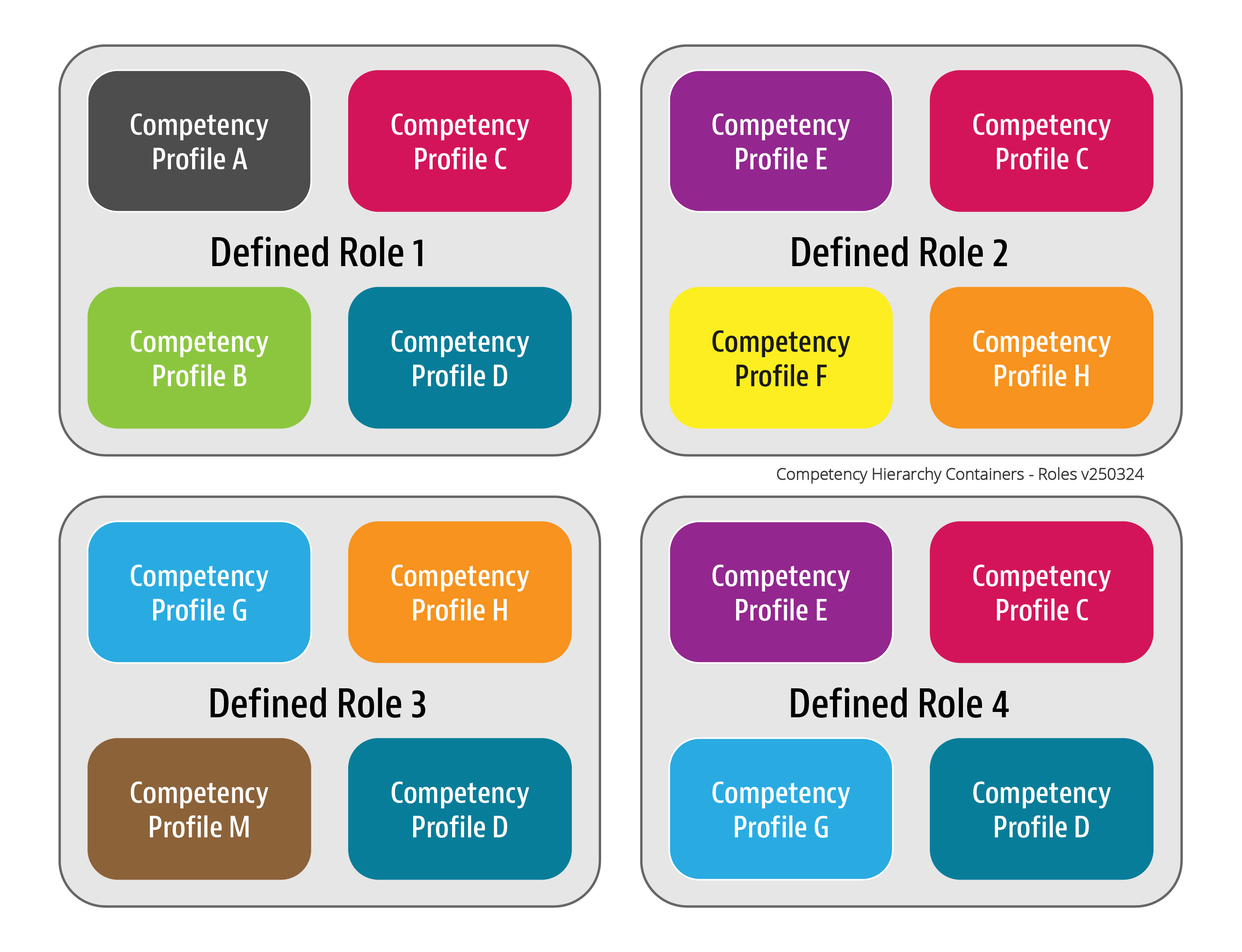
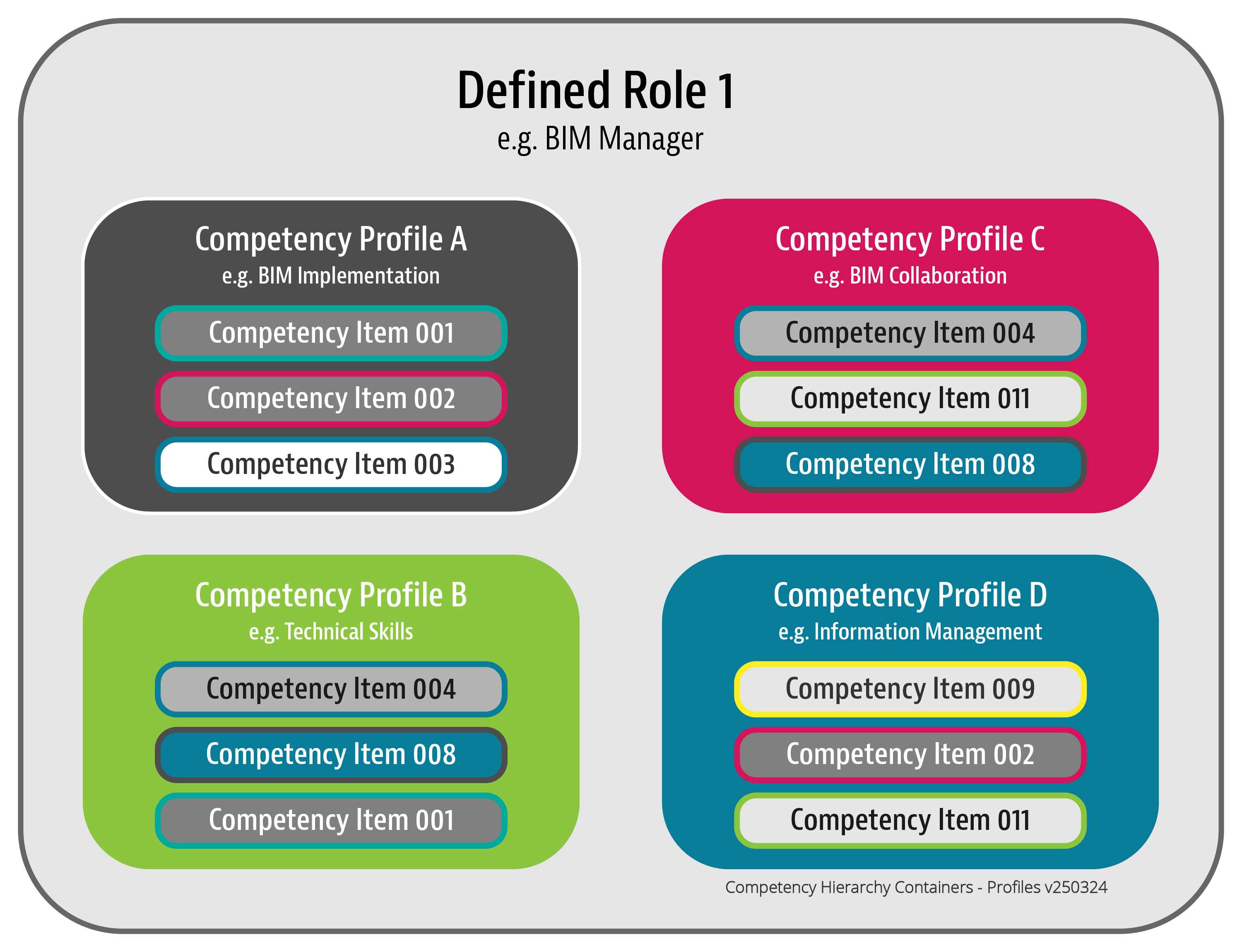
Model at a glance
Three entities, two indices, one classification. That's the whole model.
A role (e.g. BIM Manager, Junior Architect) carries scale, type, rank, discipline and region. It is the outer container that holds the profiles required to perform it.
A competency profile groups items that go together — e.g. BIM Fundamentals, Model-based Collaboration. Either core (applies to every role) or specialized.
The atomic unit. An item specifies knowledge, skill and outcome in a structured, assessable sentence.
Flows — the navigational layer
Once a persona's role and competency profiles are defined, a flow translates them into a project journey. Each flow is the navigational layer over the BIM ecosystem: a sequence of stages that point the practitioner to the relevant standard, support, or guide at each step.
An ordered card with a title, an information-management responsibility, plain-language guidance, and links to the ecosystem materials that resolve it. Stages compose into the workflow the persona follows.
First-class entries from the existing ecosystem (ISO 19650, CWMF, the Irish BIM Mandate, Build Digital, etc.). Each stage links materials by relevance — primary, supporting, or reference.
When no existing support resolves a stage, the flow flags it with a priority and workshop evidence. Flags aggregate into the prioritised gap register that drives Phase-3 scope.
Every stage→material edge is recorded in the cross-reference register so the library stays coherent as standards evolve and new supports are added.
Action statements — the atomic unit
Every item is an Action Statement: a structured sentence that defines an activity, output, or outcome. Each one begins with a verb from a fixed taxonomy and references terms drawn from international standards (ISO 19650, the BIMe Dictionary).
establish the project’s Information RequirementInformation Requirement — Description unavailable.s
“Establish the delivery team’s mobilization plan.”
“Identify the assets for which information shall be managed.”
“Determine if the project team is capable of managing federated models.”
The two indices
Every role↔profile edge carries both. They answer different questions.
Differentiates competencies by their importance to role performance, from Not Required (0) to Required (4).
- 0Not Required
Competencies outside the profile scope for this role.
- 1Optional
Supplementary competencies — nice to have, but not needed to perform the role.
- 2Recommended
Performance-enhancing competencies that improve outcomes without being standard practice.
- 3Expected
Standard-practice competencies that a practitioner in this role should hold.
- 4Required
Critical, non-negotiable competencies without which the role cannot be performed.
Measures an individual's ability to perform a defined activity or achieve a specified outcome, from No Competence (0) to Expert (4).
- 0No Competence
No demonstrable ability in the subject area.
- 1Basic
Understands fundamentals and has some initial practical application.
- 2Intermediate
Solid conceptual understanding and some practical application.
- 3Advanced
Significant conceptual knowledge and substantive practical experience.
- 4Expert
Extensive knowledge, refined skill, and prolonged experience in the activity.
Classification
Each profile is attached to a role with a classification that describes how central it is.
Universally applicable to every defined role — foundational BIM competencies.
Central to the role's scope of work — the competencies that define day-to-day delivery.
Secondary competencies that complement the primary set without defining the role.
Reading a matrix cell
One worked example. The same encoding is used everywhere IRI/ICI appear together.
Core · Individual Responsibility Index 4 (Required) · Individual Competency Index 3 (Advanced).
The hue marks the classification. The outline thickens with IRI depth — the higher the responsibility, the more prominent the edge. The small filled square saturates with ICI depth. Numbers (R for IRI, C for ICI) are always visible for precision.
An empty cell means no edge is defined between that role and profile at this version of the framework.
Sources & references
Project documents that ship with this app, and the foundational publications behind Project C.
- BIM Roles and Competency Profiles for Brazil — v1.4 (BIMei + BFB, Dr. Bilal Succar). §2.4 defines IRI and ICI.
- BIMei Competence Matrix Brief — conceptual summary of the role↔profile matrix (IRCM).
- BFB Roles and Competencies Report — Introduction — programme context for the Brazilian competence framework.
- Redefining Competence — A Five-Component Model for Digital Transformation
BIM ThinkSpace (2024), Episode 25. bimthinkspace.com/2024/11/episode-25-redefining-competence.html
- An integrated approach to BIM competency acquisition, assessment and application
Succar, B., Sher, W., & Williams, A. (2013). Automation in Construction. doi:10.1016/j.autcon.2013.05.016 · bit.ly/BIMPaperA6
- 201in Competency Table
BIMei (2016). bimexcellence.org/resources/200series/201in
- 211in Model Uses List
BIMei (2015). bimexcellence.org/resources/200series/211in
- 351in Model Use Templates Guide
BIMei (2020). bimexcellence.org/resources/300series/351in-model-use-templates-guide